Luminescent Lanthanides Compounds, Optical Spectroscopy and Bioimaging

Our Research
Our team design, synthesize, characterize, analyze and test new molecular systems and nanomaterials for bioanalytical applications and for optical and multimodal biological imaging of cells and small animals.
The activities of the team are cross-disciplinary and range from the design of molecules and nanomaterials to applications in optical and multimodal imaging, including instrument development.
The team has a particular interest and expertise in molecules and nanoamaterials that emit in the near-infrared.
A distinctive feature of the group's approach is to take into account the specific needs of biology and medicine in the design of molecules and/or nanosystems.
The team has a transdisciplinary expertise in the fields of organic, inorganic and nanomaterial synthesis, spectroscopy, biology, biochemistry and biophysics, cellular and small animal optical imaging, with a specialisation in the near-infrared.
To achieve its goals, the team is working on several types of lanthanide compounds, including small molecules, macromolecules and nanomaterials. In addition to the functional aspects of luminescent systems, the team is interested in (i) gaining a better understanding of the interactions between probes and biological targets, and (ii)
studying biochemical activity in model and real cellular environments. These objectives require the simultaneous development of synthesis methodologies and characterization techniques, such as spectroscopy and optical macro/microscopy.
Latest News
We are delighted to announce the publication of our latest article in JACS.
https://pubs.acs.org/doi/10.1021/jacs.5c12757
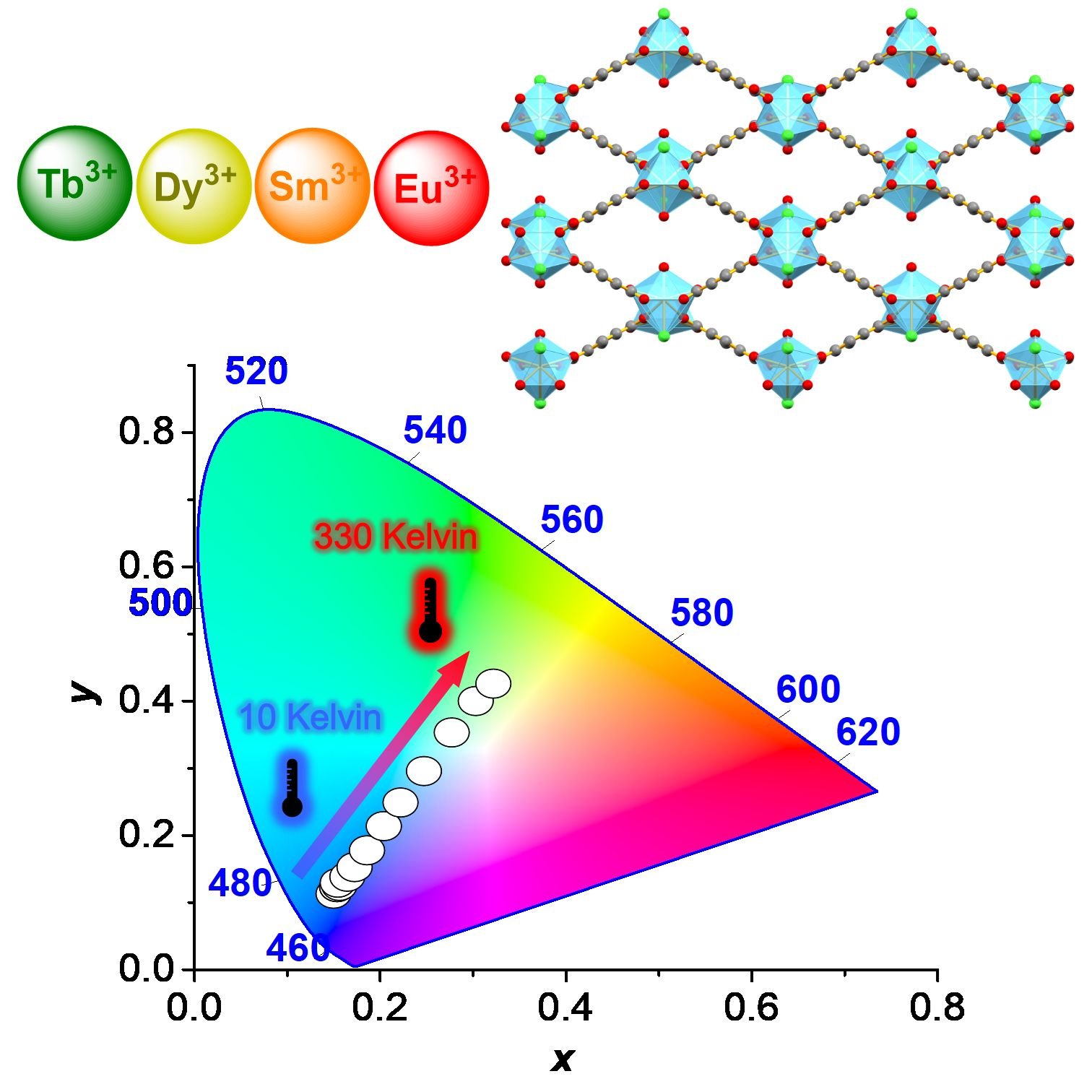
To address the strong demand for thermometers that can measure temperatures with high precision and nanometric resolution, we have designed, synthesized, and characterized new metal-organic frameworks (MOFs), which, due to their structures, possess the unique ability to incorporate different amounts of lanthanides in a controlled manner.
These new MOFs can incorporate very small amounts of luminescent lanthanides (as low as 10 mol%—the lowest value measured to date) while retaining their ability to emit luminescence signals. Thanks to this disruptive approach, we have shown that these metal-organic networks function as ratiometric luminescence thermometers over a wide temperature range, including cryogenic (10-110 K) and ambient (70-330 K) conditions.
They offer relative detection sensitivities (Srel) of up to 11.1% K-1 in the cryogenic range and 2.2% K-1 at higher temperatures, which is comparable to the highest values reported in the literature.
This work is the outcome of a synergistic international collaboration between Professor Theodore Lazarides and Dr Athanasia Psalti at the Aristotle University of Thessaloniki in Greece. This was possible through the visit of Athanasia at the CBM with the financial support of Erasmus+.
This article is available in open access
All News
- December 2025: Publication of Svetlana's commentary "A reflection on “Intriguing aspects of lanthanide luminescence” in Chemical Sciences (https://pubs.rsc.org/en/Content/ArticleLanding/2026/SC/D5SC90251G). An exciting and inspiring perspective on applications related to lanthanide luminescence beautifully illustrated. This article is available in open access.
- November 2025: Publication of our book chapter entittled "Molecular recognition, magnetic, and photophysical properties of 3d-4f metallacrowns" in the prestigious Handbook on the Physics and Chemistry of Rare Earths (https://www.sciencedirect.com/science/chapter/handbook/abs/pii/S0168127325000194).
It is the outcome of a synergistic effort between great colleagues we have been collaborating with since many years: the Pecoraro (https://lsa.umich.edu/chem/people/faculty/vlpec.html) and Zaleski (https://www.ship.edu/academics/cas/chemistry/faculty_and_staff/curtis_zaleski/) teams.
We thank Jean-Claude Bünzli and Susan Kauzlarich for the invitation to write this chapter.
- October 2025: Petra wins the prize for the best oral presentation at the Biotechnocentre conférence (https://biotechnocentre.fr/37e-colloque-biotechnocentre-16-et-17-octobre-2025/) in Orléans for her talk entitled “Regulation of SKCa channels by the cAMP/PKA pathway in cancer cells: development of new optical imaging tools in the near infrared”. This thesis is jointly directed by our long-term collaborator Christophe Vandier (https://n2cox.univ-tours.fr/) and Stephane Petoud and co-supervised by Aurélie Chantôme and Julie Bourseguin.

- October 2025: Publication of Tim's article "Near-Infrared-Emitting Lanthanide(III)/Gallium(III) Metallacrowns with Appended Coumarins: Tuning the Sensitizer–Emitter Distance through the Linker" in Inorganic Chemistry (https://pubs.acs.org/doi/10.1021/acs.inorgchem.5c03669). We have previously reported the first example of lanthanide(III)/gallium(III) metallacrown emitting a near-infrared suitable for microscopy imaging of living HeLa cells that we have published in June (https://pubs.rsc.org/en/content/articlelanding/2025/sc/d5sc01320h). We report here on a new series of metallacrowns (MCs) where the distance between the coumarin sensitizer and the NIR-emitting lanthanide is reduced by 5 Å, maximizing the energy transfer efficiency.
Compared to the previous generation, this new series of MCs generate about 9 times (erbium), 6 times (neodymium) and 3 times (ytterbium) more photons in the NIR spectral domain, enabling their detection through a 1 millimeter thick tissue-mimicking phantoms.
- June 2025: Publication of Tim's article "Novel lanthanide(iii)/gallium(iii) metallacrowns with appended visible-absorbing organic sensitizers for molecular near-infrared imaging of living cells" in Chemical Sciences (https://pubs.rsc.org/en/content/articlelanding/2025/sc/d5sc01320h). In this work, we present the first example of near-infrared (NIR) biological imaging of living cells using a lanthanide(III)/gallium(III) metallacrown. Using a click chemistry approach, the metallacrown scaffold was functionalized with biocompatible organic chromophores, which were successfully used for the sensitization of NIR-emitting lanthanides under visible light excitation. This new metallacrown is stable under biological conditions and shows no significant cytotoxicity, enabling the biological imaging of living HeLa cells in the NIR-II window.
This article is available in open access.
This article was highlighted by CNRS Chimie: https://www.inc.cnrs.fr/fr/cnrsinfo/des-couronnes-lumineuses-pour-voir-au-coeur-du-vivant) and on the 4th of September edition of the CNRS Chimie journal.